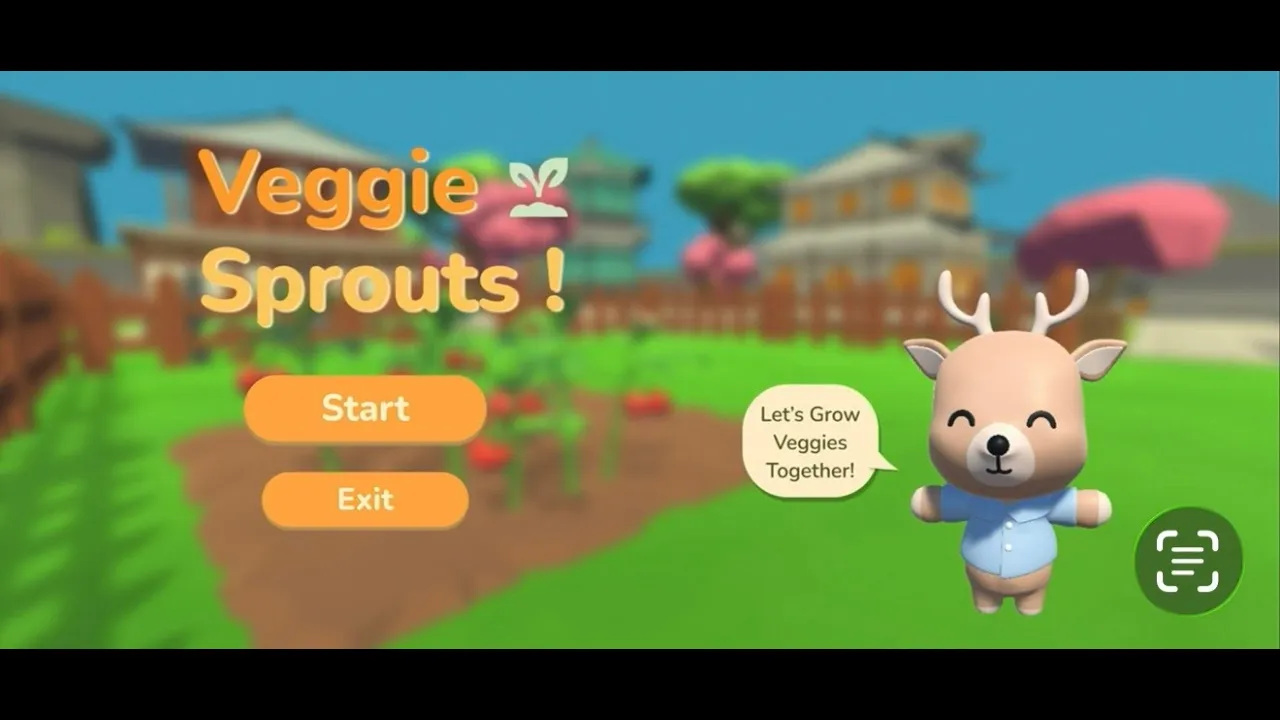
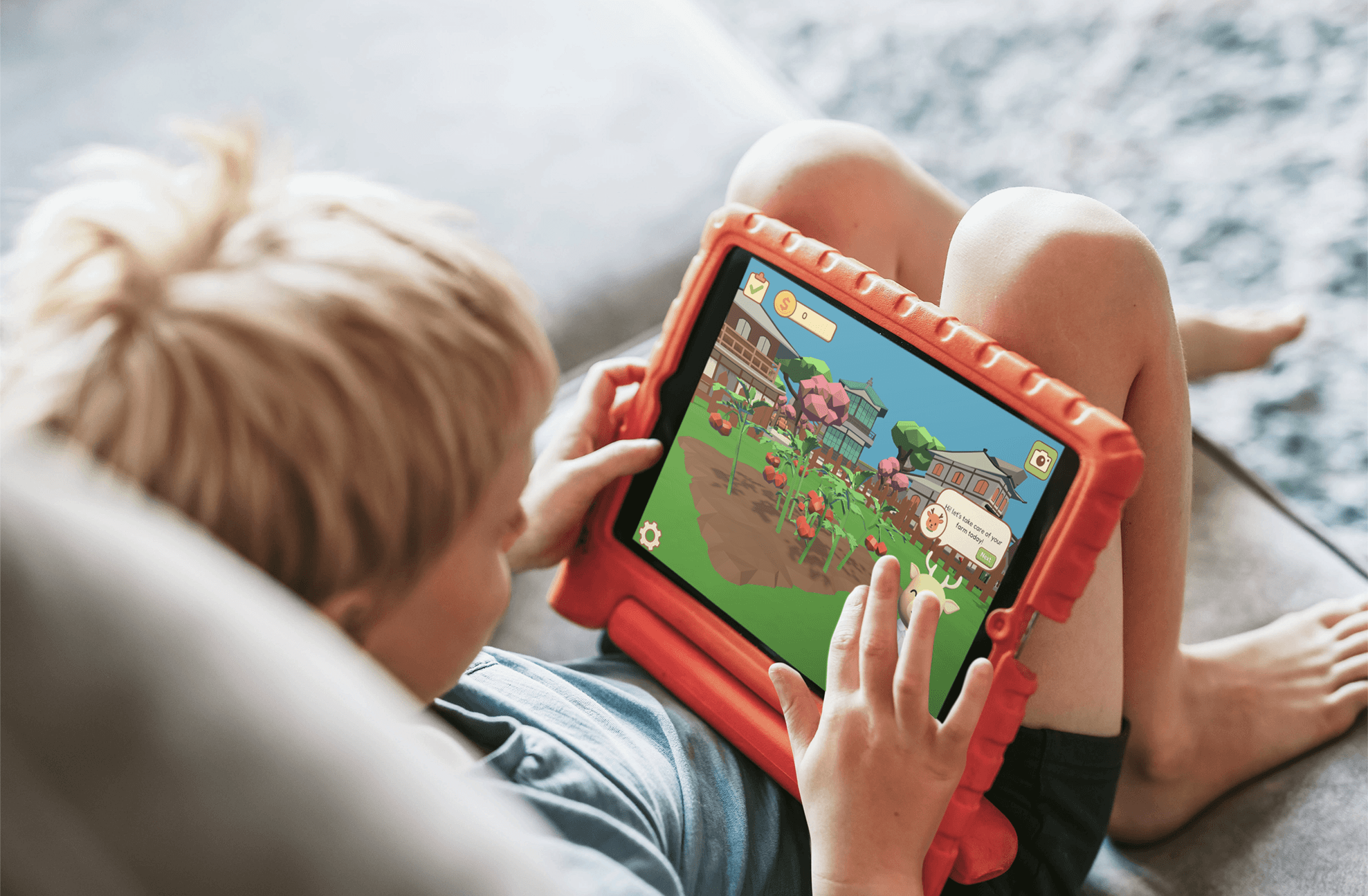
Veggie Sprouts!
An AR-Based Veggie Detection Game
Sep 2025 - December | Role: Game Designer/Programmer
Veggie Sprouts! is an interactive detection-based game that combines playful interaction with real-time recognition mechanics. Players identify and interact with different vegetables through physical actions, turning everyday objects into game inputs.
Background
A Common Struggle
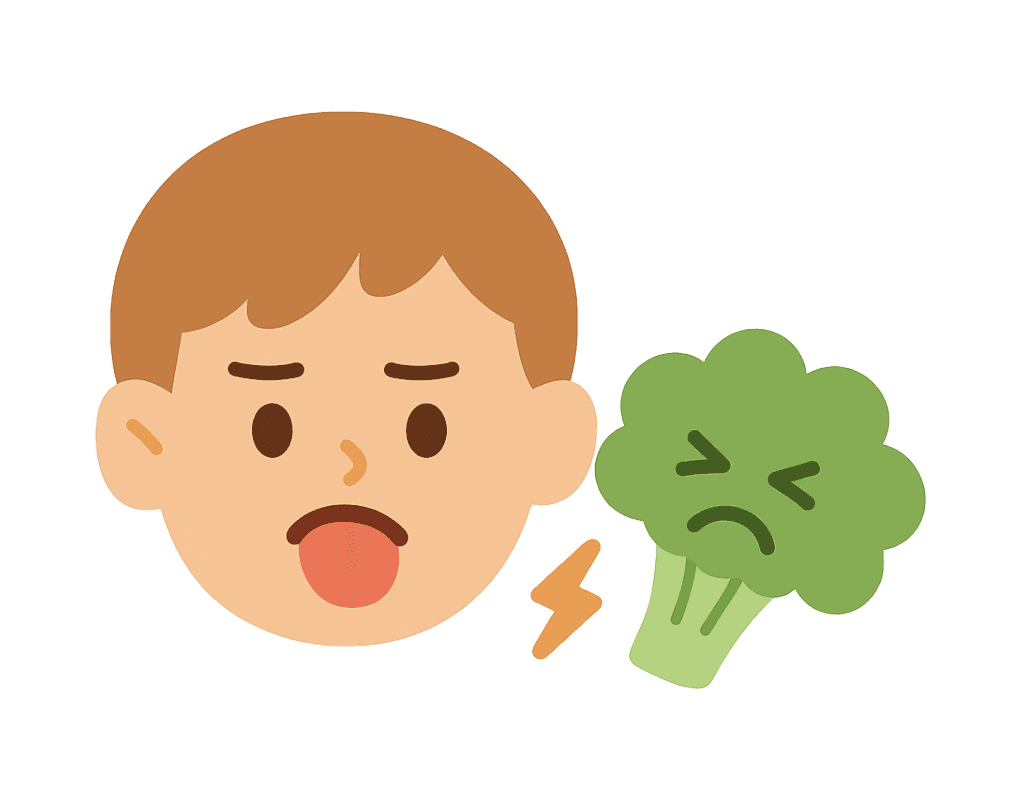
As children grow, refusing to eat vegetables becomes a familiar scene at every dining table. Parents try to encourage healthy eating, while kids push the plate away.


Nooo! Not broccoli again.
Emotional Rejection

Key Insights
49%~52%
kids do not eat daily veggies

≈
among kids aged between 4-8 years old
kids prefer snacks over veggies
>70%

commonly rejected vegetables include beetroot, lettuce, and broccoli.
Children are as likely to dislike vegetables if their parents do.
About are picky eaters among 3 - 11 years old children, may have huge impact.
The mean vegetable intake was approximately , which falls well below the daily amount.
Most
186g/day
as twice
13%-22%




Research
Why kids dislike vegetables? Consequences of Poor Intake
Many vegetables naturally taste bitter, and children’s taste buds are more sensitive. Some vegetables feel “hard” or “dry” when chewed, making them less appealing than soft, tender foods.
Compared to colorful, playful snacks and candies, vegetables often look “plain” or “boring.” Kids are more drawn to foods that look like cartoons or have expressive faces.
When vegetables are rarely served at home, children become more resistant to eating them. Kids tend to copy — if others dislike vegetables, they’ll likely reject them too.
When parents or teachers insist on eating vegetables, children may develop resistance. Eating vegetables is rarely rewarded, while snacks are often linked to rewards.








Taste & Texture
Habits & Preference
Eating Experience
Visual Appeal




A poor intake of vegetables can lead to nutrient deficiencies, weakened health, slower development, and long-term unhealthy eating habits.


Brain System
Lack of Iron and Zinc affects attention, learning, memory.
Eyes
Lack of Vitamin A → leads to poor vision and dry eyes.
Heart System
Unbalanced die increases risk of heart disease and type-2 diabetes.
Immune System
Vitamin C & K deficiency leads to weaker immunity and slower wound healing.
Muscles & Bones
Lack of iron & minerals causes anemia, weakness, and poor bone development.
Overall Body
Risk of obesity from high calorie food, and lower growth rate due to nutrient deficiency.
Digestive System
Lack of dietary fiber results in constipation and poor digestion.






Skipping vegetables may seem small, but it quietly impacts every part of the body. Eating colorful veggies every day helps children stay strong, focused, and happy from the inside out.
Problem Definition
Children aged 4–8 often show avoidance toward vegetables, driven by emotional resistance, distraction, or a lack of positive reinforcement. Understanding these patterns helps frame eating as an act that can be both meaningful and enjoyable.
Types of Vegetable Avoidance
5
1

Selective Eater
Picks certain veggies only (e.g. eats kyle, avoids carrots).
Veggie Rejecter
Refuses vegetables entirely, even when disguised in food.
2

Slow / Distracted Eater
Delays eating vegetables by playing or talking.
3

Emotional Resister
Cries, complains, or frowns when forced to eat veggies.
4

Habitual Skipper
Rarely chooses vegetables
voluntarily in daily meals.

Design Scenarios
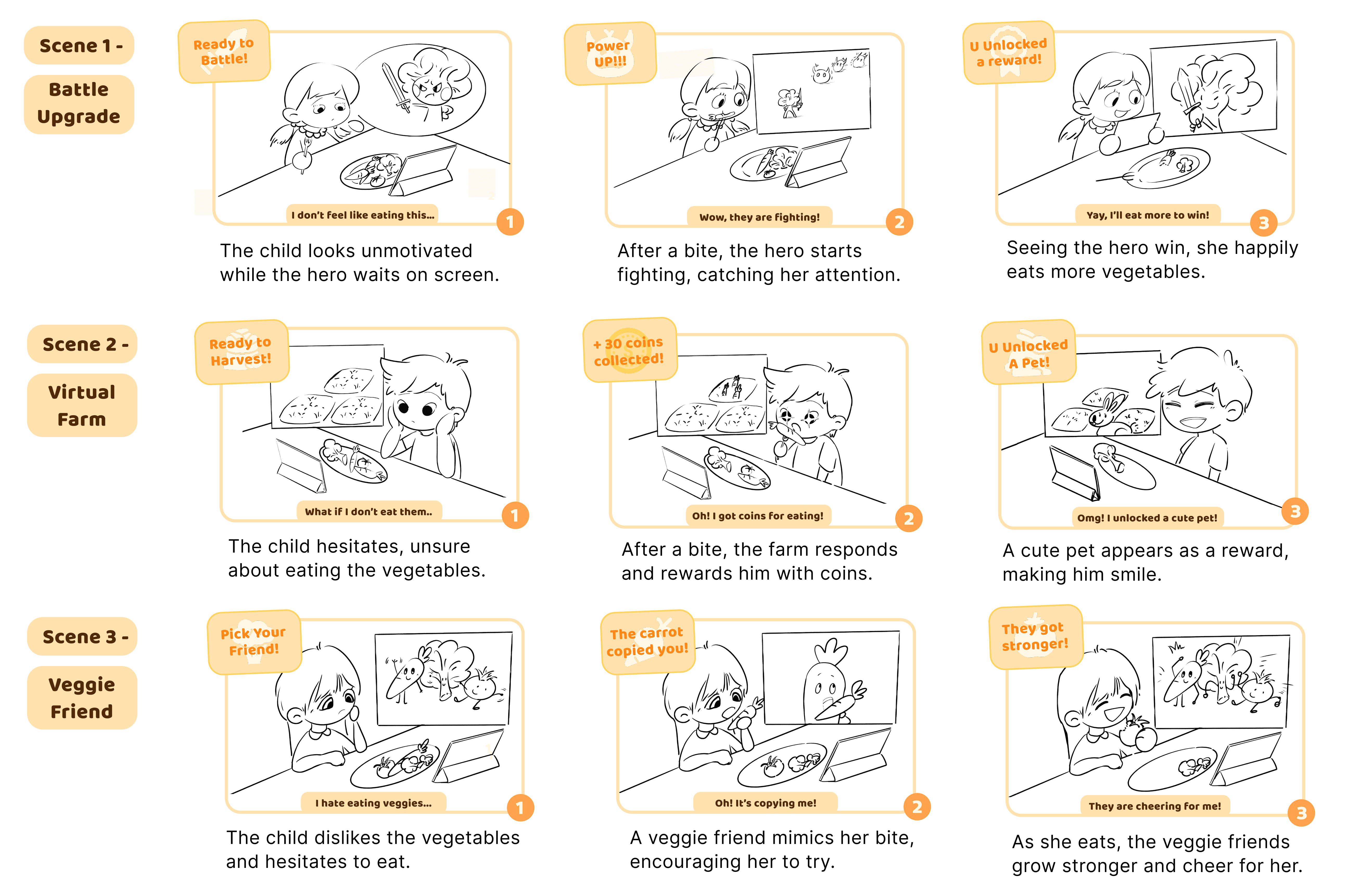
I designed three interactive scenarios, which will be used for interviews with parents and children to understand their needs, motivations, and attitudes toward gamified eating experiences.
Interview
The goal of this interview study was to understand children’s eating habits and motivations in real family settings, and to explore how game-based design elements could encourage them to eat more vegetables in enjoyable and sustainable ways.
Interviewee Profiles

6 years old
“If my veggie pet grows when I eat, I’ll eat more.”
Emma
Leafy greens, especially
carrots and bok choy
Fruits (bananas, grapes, strawberries)

Favorite game: Math Island Adventure
Like cute characters (elf, princess)

Insights from Parents Interview

Emma’s parents hope for a playful system that shows their kid’s visible growth and daily progress in eating vegetables.
Liu Family


8 years old

“If my sword glows when I eat carrots, that’s cool!”
Leo
Avoids bitter greens,
like spinach

Enjoys sweet and chuncky food

Favorite game: Minecraft, Eggy party
Often distracted during meals
Insights from Parents Interview

Leo’s parents hope for a consistent, goal-oriented system that turns eating into a fun, measurable challenge.
Zhang Family


Game Scenario Feedback


Emotional bonding turns eating into a caring act.

Emotional Motivation
Children relate to the veggie as a friend, not a task.

But requires strong link to
real-world actions
“It’s not fun anymore when the power stops going up.”
“I want to see my pet grow, but faster!”
-Emma, 6
-Leo, 8

Immediate feedback boosts motivation

Growth-based rewards encourage daily, consistent behavior.
Kids like competitive elements

Requires additional short-term feedback to sustain attention.

“I only feed it in the game… it doesn’t make me wanna eat for real.”
Motivation fades once rewards stop appearing
-Emma, 6
Long-term Engagement
Short-term Excitement
Battle
Upgrade

Veggie Friend
Virtual
Farm
Iteration
After the interview, I found that children enjoy instant rewards that make eating fun, but their motivation lasts longer when they can watch something grow or evolve over time.
Based on this, the design will pair real eating actions with a simple growth-and-reward loop, supported by a friendly veggie companion that guides the experience.
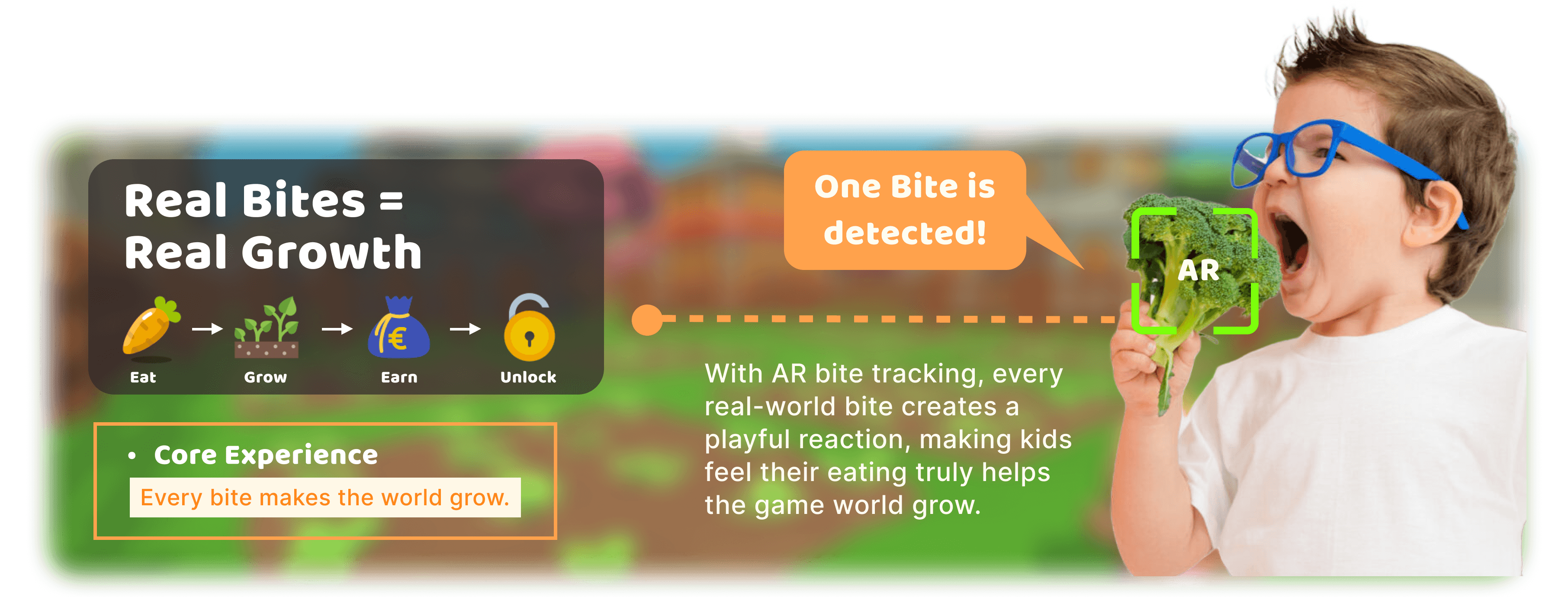
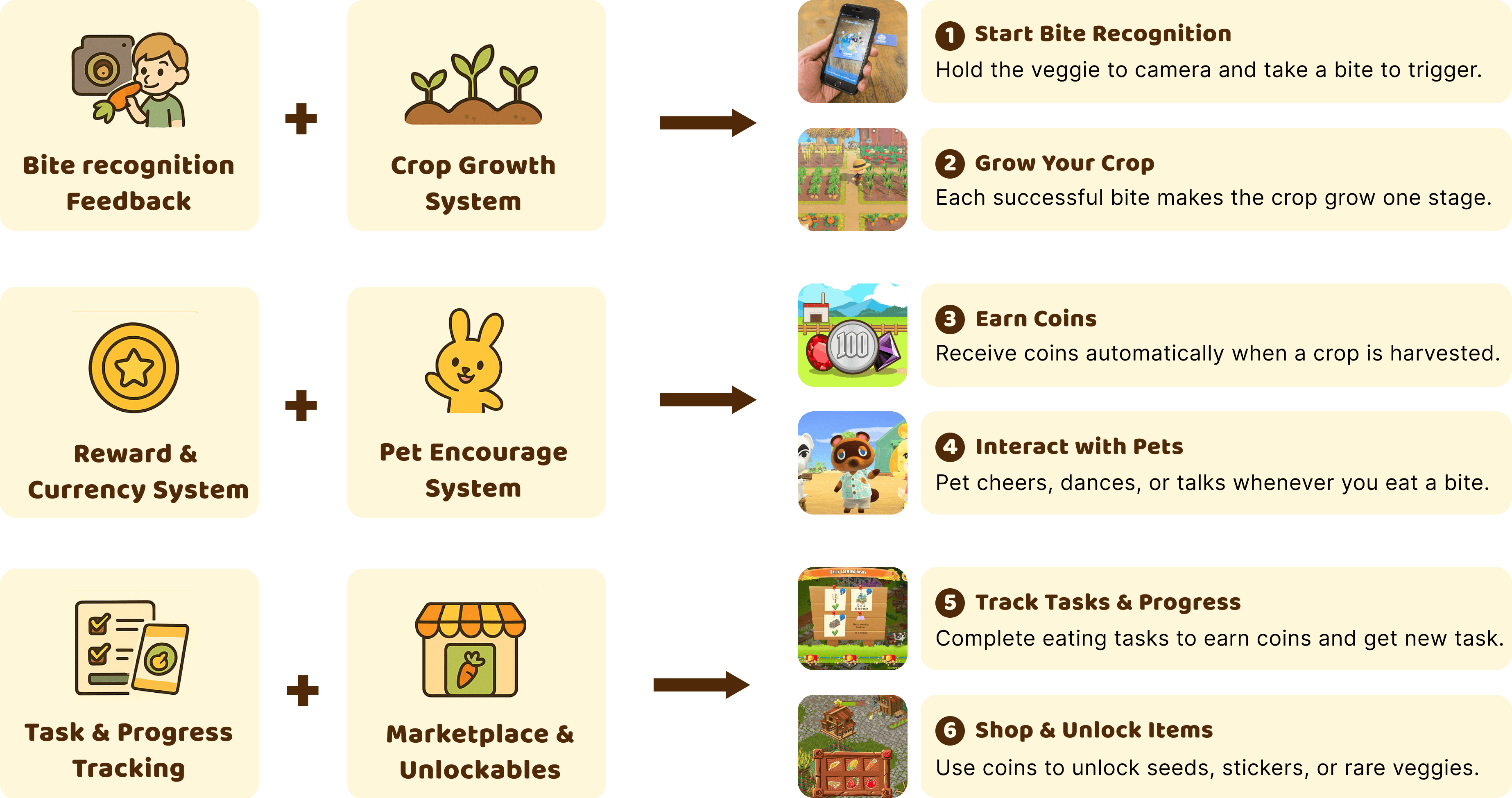
Veggie Capture: The whole game is driven by Unity and AR Foundation, which will be embedded into the game. When the system detects that the child has eaten a real vegetable, it instantly rewards them with coins.
These rewards can be used to unlock decorations or seeds, allowing children to grow and personalize their own farm in a fun way.
This design aims to encourage children to develop sustainable healthy eating habits through a cycle of play, feedback, and emotional connection.
By linking real eating actions with in-game rewards and companion growth, children gain both instant satisfaction and a sense of long-term achievement.
Design Direction
Core Mechanics
Expected Outcomes
Game Inspiration
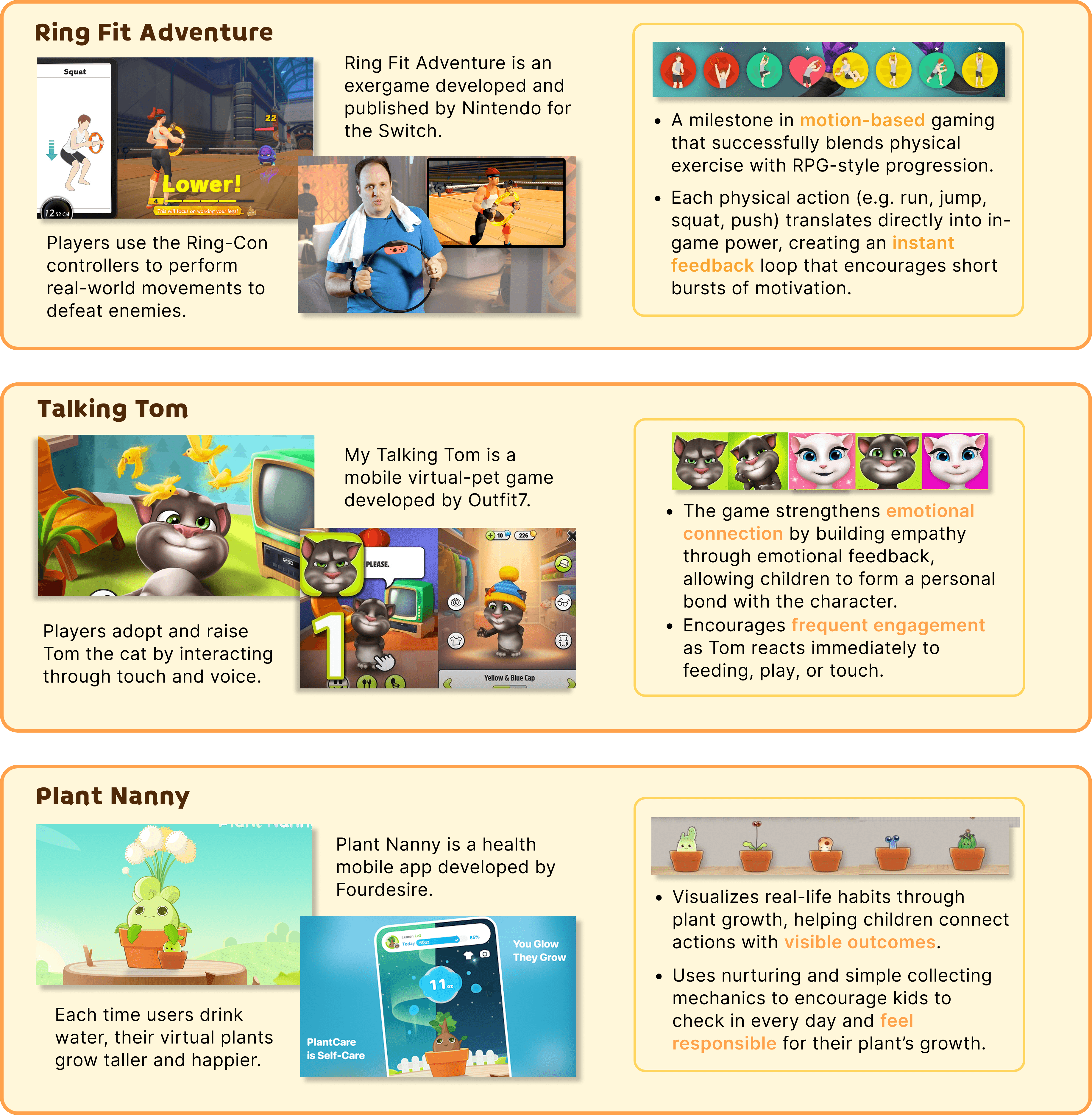
Game Concept
What is About
It is an interactive eating game designed for children aged 4–8, aimed to help them develop healthy eating habits through playful interaction.
Core Mechanics How to Play
Method Evaluation
To connect children’s real eating behaviors with in-game plant growth, I conducted research of all possible technology, and the below is reasoning behind final consideration.
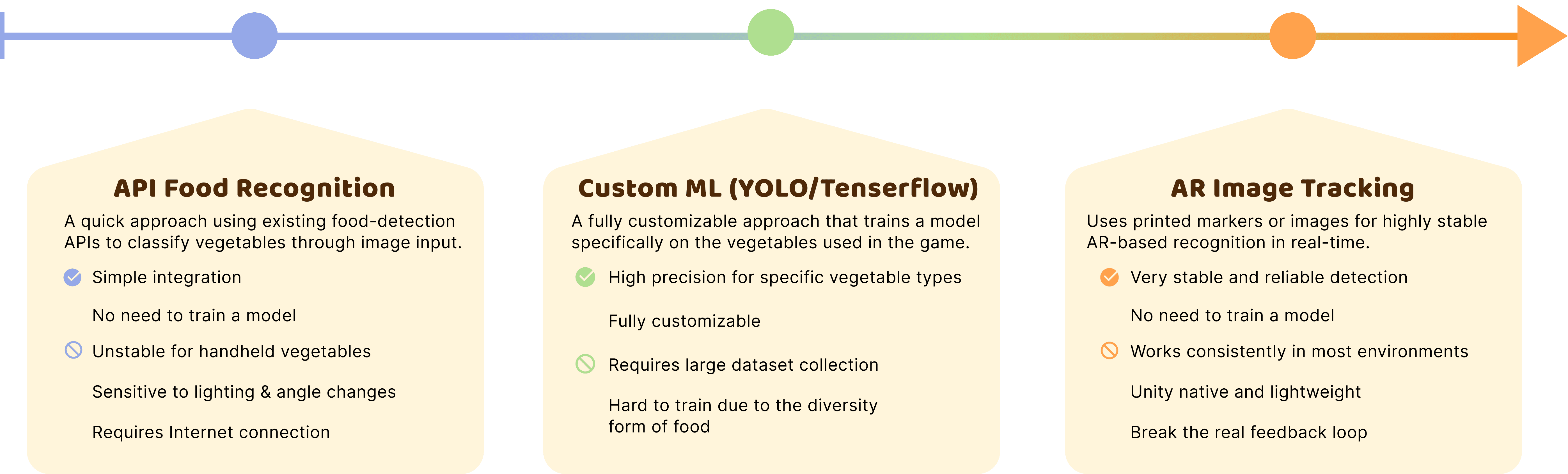
Technical Realization
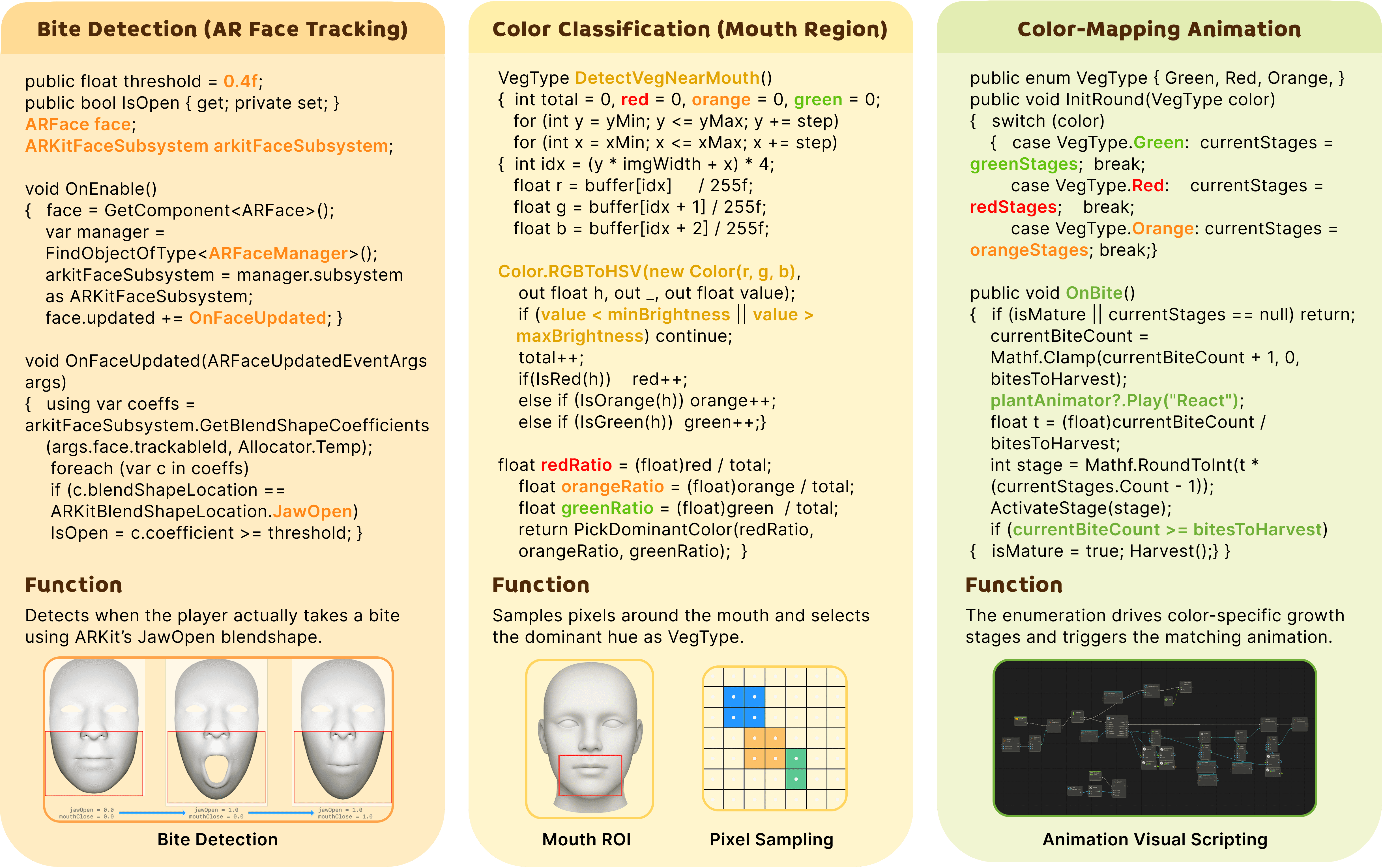
Color Based Veggie Recognition with AR Foundation (Unity, Real-Time CPU Image Processing)
Finally, I adopted a color-based method by sampling the AR camera feed around the mouth and classifying the dominant hue in HSV. This runs fully offline, reacts instantly, stays stable under daily lighting, and still preserves the core interaction — “eat veggie → grow vegetables.”
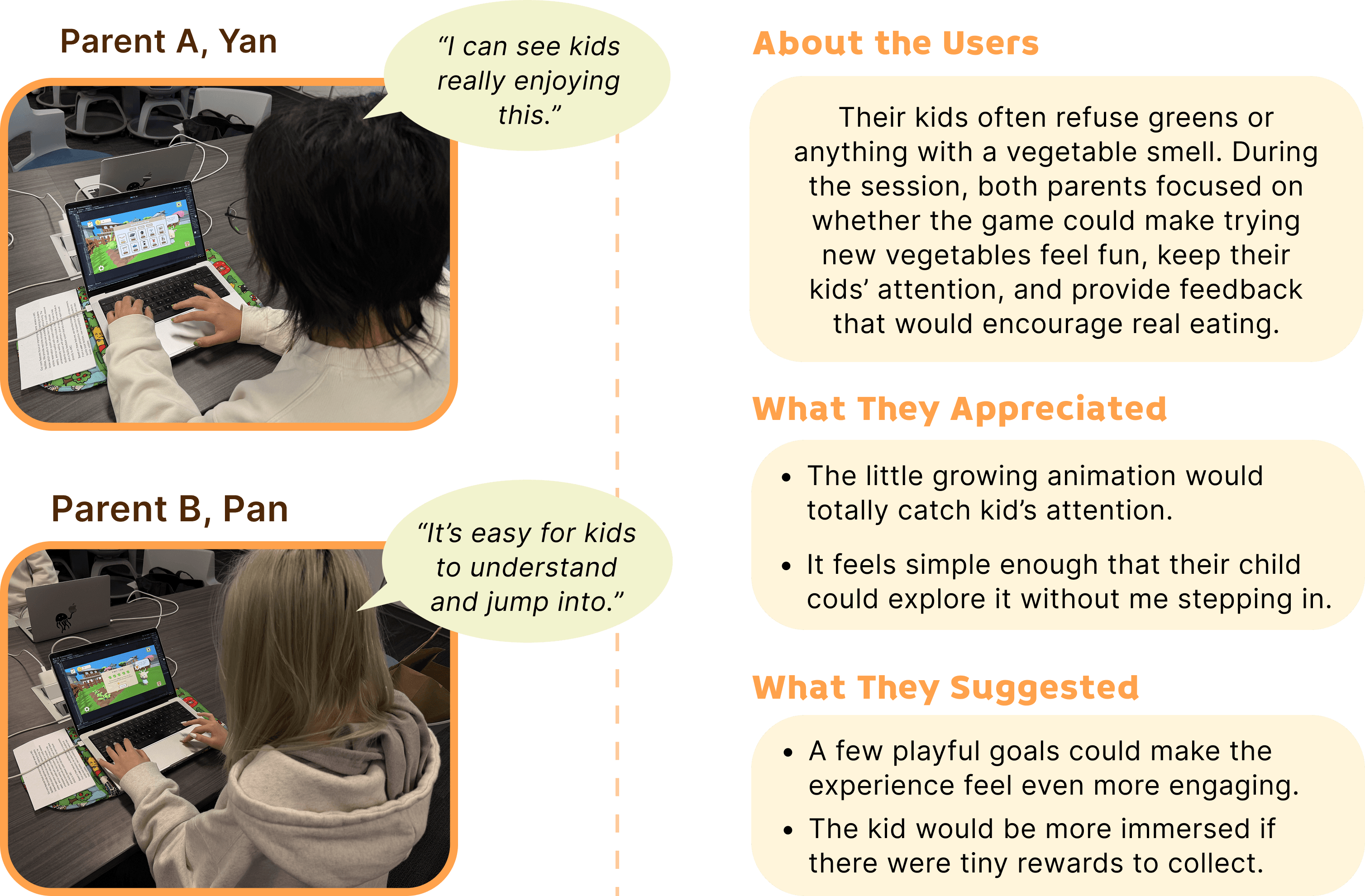
User Testing
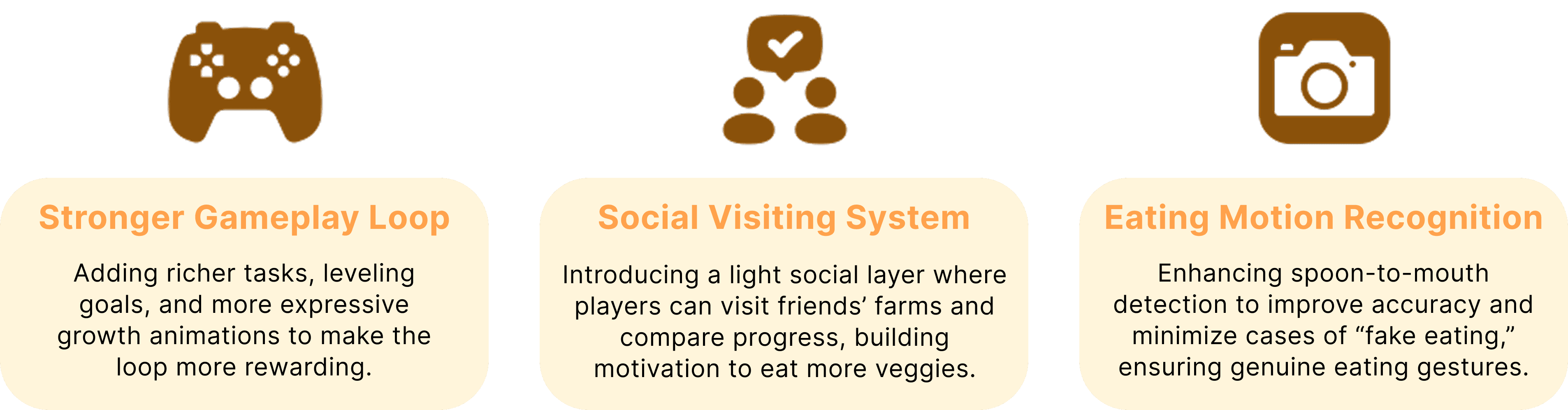
Future Improvement
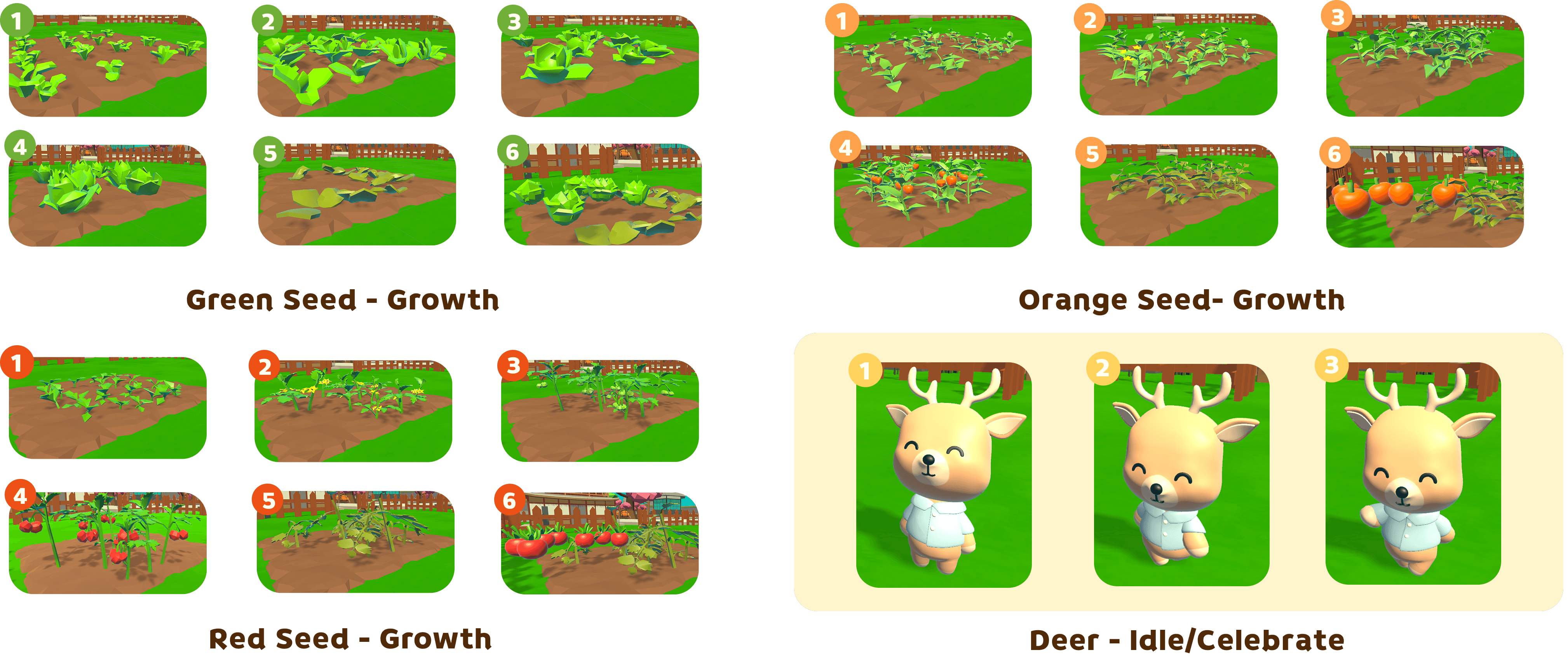
Final Game Display - Art Assets
UI Design
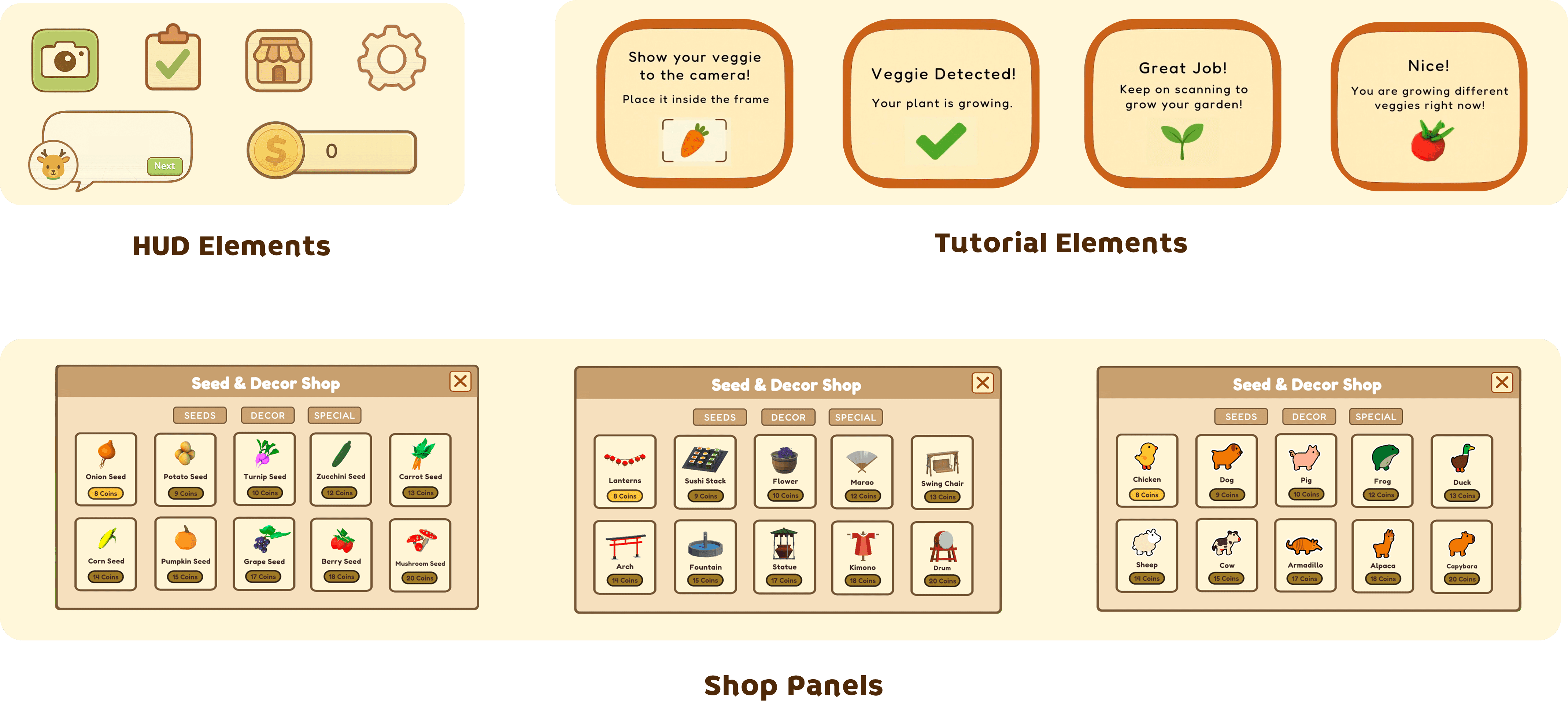
Animation Design
Final Game Display - Flow
